
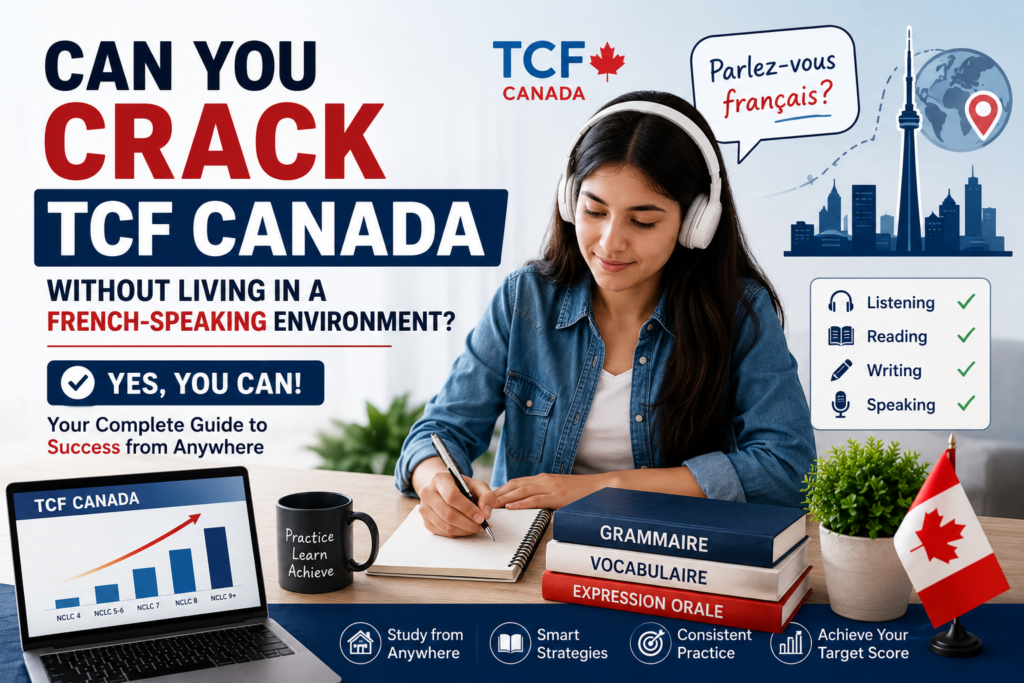
Many aspiring immigrants and French learners believe that passing TCF Canada requires living in France, Quebec, Belgium, Switzerland, or another French-speaking region. This is one of the biggest myths surrounding the exam. In reality, thousands of candidates successfully achieve competitive TCF Canada scores every year while living in countries where French is rarely spoken. With the growing popularity of Canadian immigration programs and increased demand for French-speaking candidates, more learners are preparing for TCF Canada entirely online from countries such as India, the Philippines, Nigeria, Pakistan, the UAE, and many others. The key factor is not where you live—it is how effectively you create a French-learning environment around yourself.
TCF Canada (Test de Connaissance du Français pour le Canada) is one of the official French language tests accepted by Immigration, Refugees and Citizenship Canada (IRCC) for Express Entry and various immigration pathways. The exam evaluates four core language skills: listening, reading, writing, and speaking. All four modules are mandatory for immigration purposes. The results are converted into NCLC (Niveaux de compétence linguistique canadiens) levels, which directly impact immigration eligibility and CRS scores.
Why French Is Becoming More Important for Canada Immigration
One of the biggest immigration trends in 2025 and 2026 is Canada’s continued emphasis on attracting French-speaking immigrants outside Quebec. Strong French proficiency can significantly improve an applicant’s competitiveness within the Express Entry system. As a result, interest in TCF Canada and TEF Canada has increased dramatically among international applicants seeking additional CRS points and access to Francophone immigration streams. Both TCF Canada and TEF Canada remain officially accepted French language tests for Canadian immigration.
The good news is that modern technology has completely transformed language learning. Today, students can access French podcasts, YouTube channels, online tutors, AI-powered learning tools, mock exams, speaking partners, and virtual classrooms from anywhere in the world. This means that geographical location is no longer a major barrier to achieving high scores in TCF Canada.
What Makes TCF Canada Challenging?
The biggest challenge for candidates outside French-speaking environments is exposure. Unlike learners living in Quebec or France, international students may not hear French conversations regularly. This can affect listening comprehension and speaking fluency. However, these challenges can be overcome through deliberate immersion strategies.
The TCF Canada exam tests practical communication skills rather than academic memorization. Candidates need to understand spoken French, interpret written texts, express opinions clearly, and communicate naturally in speaking tasks. Consistent exposure to authentic French content can help bridge the gap between classroom learning and real-world communication.
Recommended TCF Canada Score Targets
Many candidates prepare for specific NCLC benchmarks because they influence immigration outcomes.
| NCLC Level | Approximate CEFR Level | Importance for Immigration |
|---|---|---|
| NCLC 4 | A2 | Basic eligibility in some programs |
| NCLC 5-6 | B1 | Intermediate proficiency |
| NCLC 7 | B2 | Common target for Express Entry applicants |
| NCLC 8 | B2+ | Strong competitive profile |
| NCLC 9 | C1 | Significant CRS advantage |
| NCLC 10+ | C1-C2 | Advanced French proficiency |
TCF Canada scores are converted into NCLC levels for Canadian immigration purposes, making benchmark-based preparation far more effective than focusing solely on raw scores.
How to Create a French-Speaking Environment at Home
The most successful TCF candidates often build their own immersive environment. Instead of studying French only during scheduled lessons, they integrate the language into their daily lives. This means listening to French podcasts during commutes, watching French news channels, changing phone settings to French, following French-speaking creators on social media, and practicing conversations regularly.
One particularly effective strategy is the “French Hour” method. Dedicate at least one uninterrupted hour daily where everything you consume—videos, music, reading materials, and conversations—is exclusively in French. Over several months, this dramatically improves listening comprehension and vocabulary retention.
Another important technique is shadowing. During shadowing exercises, students listen to native French speakers and immediately repeat what they hear. This improves pronunciation, rhythm, fluency, and speaking confidence simultaneously.
The Four Skills You Must Master
Listening
Listening is often considered the most difficult section for candidates outside French-speaking countries. The solution is daily exposure. Listen to French audio for at least 30 minutes every day. Focus on understanding context before trying to understand every individual word.
Reading
Reading comprehension improves rapidly when students read French articles, blogs, and short stories regularly. Reading exposes learners to common sentence structures and vocabulary that frequently appear in TCF Canada.
Writing
Writing requires accuracy in grammar, sentence structure, and vocabulary. Students should practice opinion-based essays, formal responses, and short written tasks under timed conditions.
Speaking
Speaking is where many learners struggle because they lack conversation partners. Fortunately, online language exchange platforms and virtual tutors provide excellent opportunities to practice real-life communication.
How Karan Kataria Online French Classes Can Help
For students preparing for TCF Canada without living in a French-speaking environment, expert guidance can accelerate progress significantly. Karan Kataria Online French Classes are specifically designed to help learners develop the four essential skills tested in TCF Canada. Through structured lessons, speaking practice sessions, personalized feedback, mock examinations, vocabulary-building exercises, and immigration-focused preparation strategies, students receive the support needed to achieve their target NCLC levels. The program focuses on practical communication, exam techniques, and confidence-building, enabling learners to compete successfully with candidates from French-speaking regions. Whether you are a beginner or an advanced learner aiming for NCLC 7, NCLC 8, or higher, expert mentorship can make the preparation journey far more efficient and effective.
The simple answer is yes—you can absolutely crack TCF Canada without living in a French-speaking environment. In today’s digital world, access to quality French resources is greater than ever before. Success depends on consistency, smart preparation, daily exposure, and strategic practice rather than physical location. By creating your own immersive French environment, focusing on all four language skills, and following a structured preparation plan, you can achieve the scores required for Canadian immigration and move one step closer to your dream of living in Canada.